
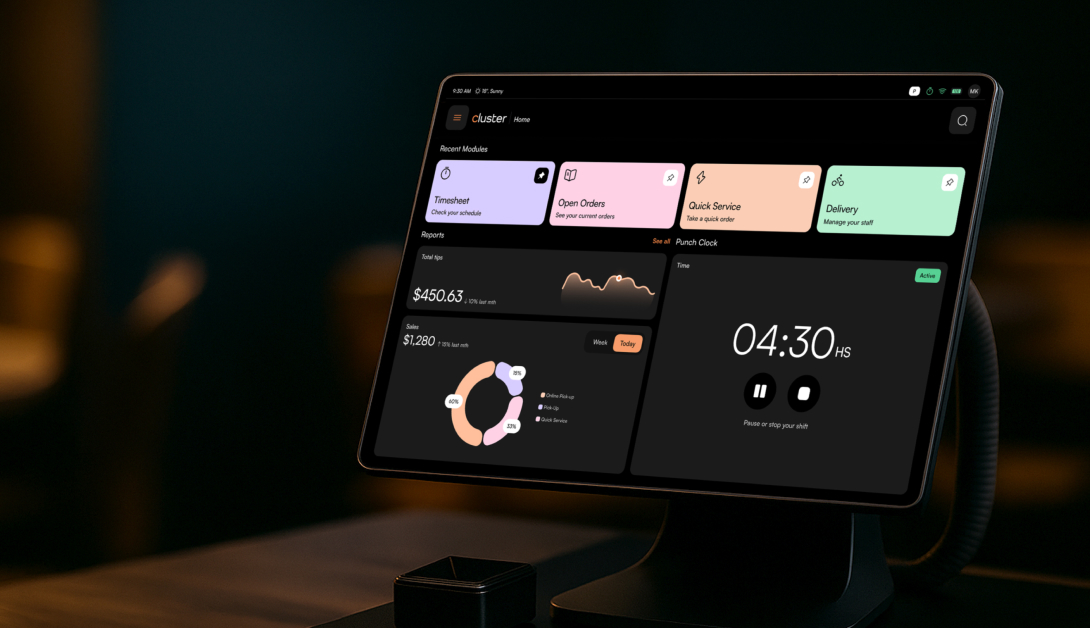

Cluster Systems / ClusterPOS
A production retail support agent that reasons across a knowledge base and live POS data, grounding every answer in a cited source. The live POS tool surface — shipped to production in May 2026 — turns a grounded chatbot into a true multi-source, tool-using agent.
The customer
Cluster Systems, known publicly for its ClusterPOS product, is a SaaS retail point-of-sale platform serving European retailers. Its product powers in-store transactions, inventory, and back-office operations for multi-location retail customers, and its support teams field a high volume of how-do-I questions. Some of those answers live in the company's Zoho-hosted knowledge base; others require live operational lookups against the POS data plane. Surfacing both through a single conversational agent — rather than two separate human-driven workflows — was the goal of the engagement.
The challenge
ClusterPOS support handled two distinct classes of question: static how-to questions already documented in the knowledge base, and live operational questions — the current state of inventory, transactions, or store status — that no static document can answer. A European retail-SaaS data-residency posture ruled out third-party SaaS chatbots, so the solution had to run inside the customer's own AWS account, and the customer had no in-house generative-AI or agent-engineering capacity to build it. They started greenfield: no prior production agent, no Bedrock usage, and no agent framework deployed.
The solution
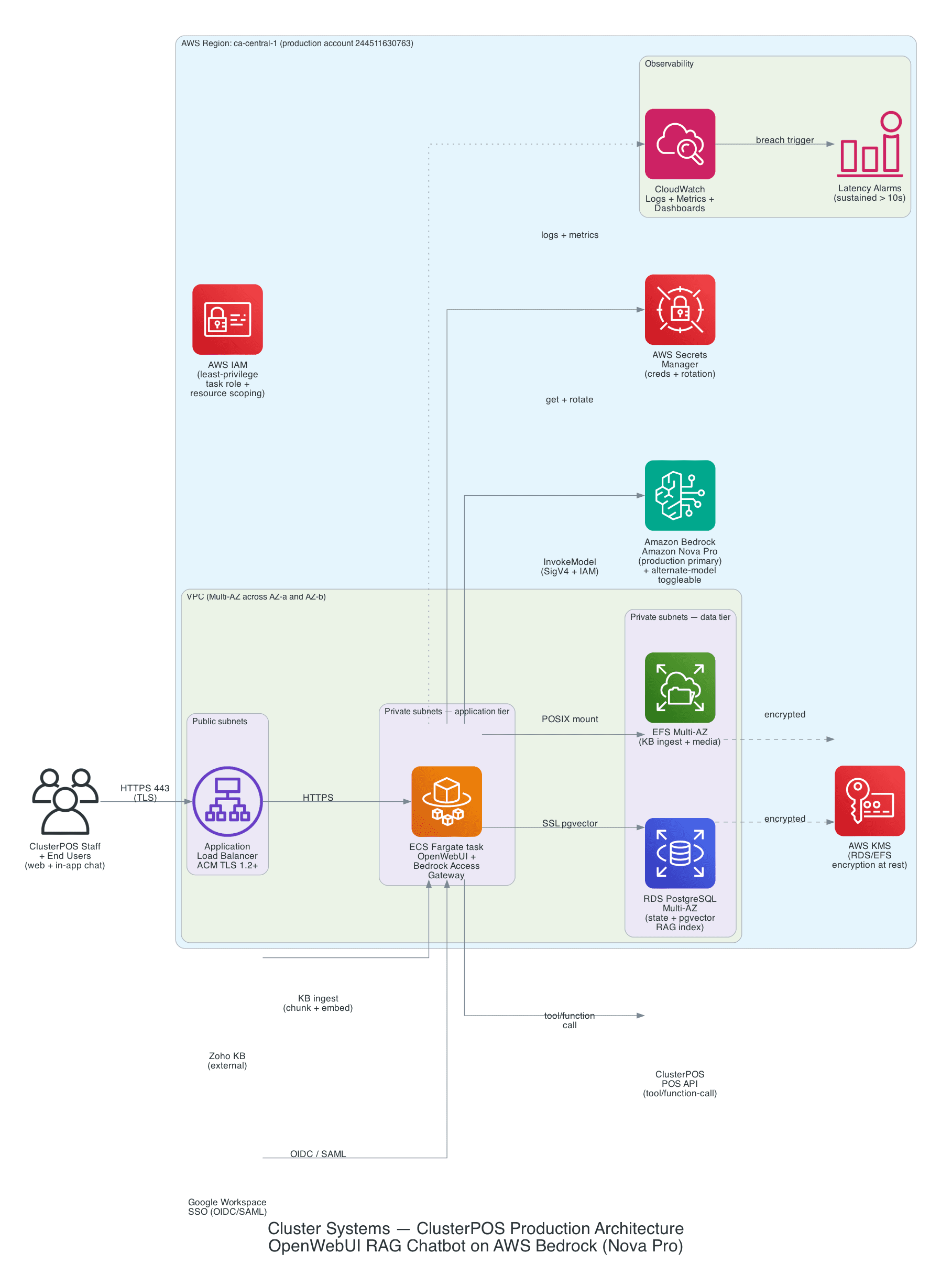
VeUP designed and deployed a production AI agent for ClusterPOS on AWS, using OpenWebUI as the agent framework and Amazon Bedrock as the inference plane. Rather than a single-shot completion endpoint, the agent interprets each query, decides which tool surface or surfaces to invoke, calls them, grounds the model on their structured returns, and cites the sources back to the user. Multi-model routing is a first-class capability: Amazon Nova Pro is the primary reasoning model, Nova Lite handles cheap-tier triage and classification, Anthropic Claude Sonnet is the premium fallback, and Amazon Titan provides RAG embeddings — with IAM scoping the agent to only the model ARNs it is permitted to invoke.
The agent reaches across two tool surfaces. The first is a Zoho knowledge-base retrieval tool over an indexed corpus of roughly 600 documents, with vector search on Titan embeddings persisted in pgvector on Amazon RDS for PostgreSQL — delivering sub-800ms retrieval. The second, shipped to production in May 2026, is a live POS API tool: an OpenWebUI function-call definition that fetches structured operational data — transactions, inventory, store status — over HTTPS, with credentials held in AWS Secrets Manager. That second tool surface is what elevates the system from a knowledge-base assistant into a multi-source, tool-using agent.
OpenWebUI and a hardened Bedrock access layer run on Amazon ECS Fargate behind an Application Load Balancer with TLS via AWS Certificate Manager. Agent state — conversation history, tool-call traces, and per-turn model selection — and the vector store both live in Amazon RDS for PostgreSQL; uploaded knowledge-base files and media live on Amazon EFS. Structured tool contracts and per-tool-surface graceful degradation keep the agent from fabricating live values when a source is unavailable, while CloudWatch dashboards and alarms monitor the agent loop end to end. The entire stack is provisioned as infrastructure-as-code and handed to the customer for ongoing ownership, with VeUP advising through an ongoing managed-services relationship.
Production outcomes
| KPI | Result |
|---|---|
| End-to-end agent latency | 1–2s typical response (SLA target p50 ≤ 5s, p95 ≤ 10s — exceeded). |
| Knowledge-base retrieval | Sub-800ms vector search across ~600 documents. |
| Production run-rate | ~$200/month base infrastructure; Fargate runtime ~$23/day after post-launch right-sizing. |
| Multi-source tool-use live | Live POS API tool surface shipped to production May 2026. |
| Continued engagement | Net-new AWS GenAI workload, followed by a managed-services attach and three downstream architecture engagements. |
Customer voice
Cluster Systems' CTO reviewed and approved use of this engagement as a public-facing case study, on the basis that it is presented positively and focuses on empowering their support team. The approved framing describes a sovereign, grounded chat platform — running in the customer's own environment — that empowers the support team rather than replacing it.
Amazon Bedrock (Amazon Nova Pro, Nova Lite, Anthropic Claude Sonnet, Amazon Titan embeddings) · Amazon ECS Fargate · Amazon RDS for PostgreSQL with pgvector · Amazon EFS · Application Load Balancer · AWS Certificate Manager · AWS Secrets Manager · AWS IAM · Amazon CloudWatch · AWS Backup · AWS KMS · Amazon VPC.