
Consumer Social Platform
A production multi-model safety-orchestration agent on Amazon Bedrock that classifies media against policy, aggregates per-frame verdicts into a single video-level decision, and orchestrates the whole pipeline with AWS Step Functions.
Customer anonymized at their request — name held on file. Architecture and metrics shown are accurate to the production deployment.
The customer
The customer is a consumer social platform — a large user-generated-content social app where people share posts, photos, and short videos with friends and a global audience. Operating at content scale across a mixed-media estate (images and multi-minute video), the platform runs a multi-account AWS environment and needed automated trust-and-safety controls that could keep pace with uploads without expanding its small in-house AI/ML footprint.
The challenge
The platform had to enforce content-moderation policy on a regulator-facing, age-restricted user cohort, where a missed exposure is a regulator-grade and reputation-grade event. Its operating rule was unambiguous: false positives are tolerable for the restricted cohort, but false negatives are never acceptable. That demanded deterministic, auditable policy enforcement across both interactive image uploads and asynchronous video at scale — with provider optionality so policy was never locked to a single foundation-model vendor, and full per-decision audit traceability for regulators.
The solution
VeUP delivered a production multi-model safety-orchestration agent, provisioned end-to-end as Terraform infrastructure-as-code in the customer's AWS account and cross-account integrated to its upload service. Rather than a generic chatbot, the system is a decomposed agentic pipeline: a design-time multi-model evaluation stage ran a structured head-to-head bake-off of five candidate engines (including Llama 4 Maverick, Llama Guard 4, Nova Premier, Claude Opus, and Amazon Rekognition) against an identical labeled dataset, each emitting a typed verdict to a comparator. Amazon Bedrock's Qwen 3 VL won on hit rate and became the sole production engine.
At runtime, Qwen 3 VL operates as a single-hop classifier-with-policy-prompt: the platform's content-policy taxonomy and an asymmetric-loss rule (“err toward the more-explicit class”) are encoded directly in the model's system prompt, so it emits a structured per-frame pass/block verdict in one Converse call — the policy-enforcement reasoning lives in the prompt, not a separate downstream model. An engine router gives both Bedrock and Rekognition the same typed verdict envelope for runtime A/B and fallback, and a K-of-N aggregator synthesizes per-frame verdicts into a single video-level decision with a tunable threshold.
AWS Step Functions orchestrates the multi-step pipeline: a Map state fans out across extracted video frames at a bounded MaxConcurrency=5 quota dial, with idempotent retries and full execution history plus CloudTrail for a regulator-facing audit trail. Containerized AWS Lambda (with ffmpeg via Amazon ECR) handles frame extraction and tool-use compute; EventBridge Pipes, API Gateway (SigV4 / AWS_IAM auth), and single-principal-scoped cross-account SNS/SQS wire the agent into the platform's existing media pipeline. VeUP deliberately chose AWS-native orchestration primitives over free-form agent frameworks for auditability, determinism, and cost predictability.
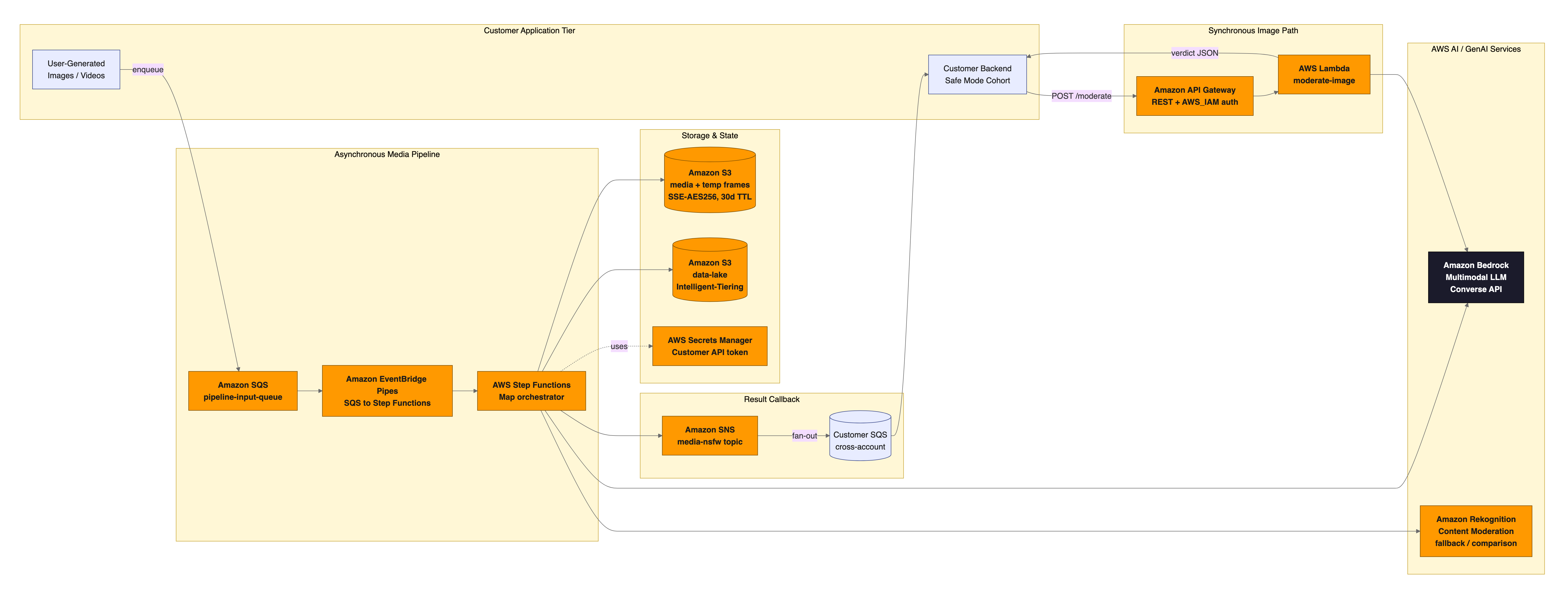
Production outcomes
| KPI | Result |
|---|---|
| NSFW classification accuracy (production) | 99.56–99.58% |
| Lift vs. naive baseline | 54% → 99.58% (+45.6pp) via prompt engineering and data curation — no fine-tuning. |
| End-to-end cost per 1,000 images | ~$1.00 (foundation-model token cost $0.20–$0.53 per million tokens). |
| Throughput (proof-of-concept) | ~1,000 images per 20–25 minutes. |
| Acceptance criteria | 11 of 11 passed. |
Engagement
A two-phase engagement — a quantitative model-evaluation proof-of-concept followed by a production go-to-market build — passed all 11 acceptance criteria and went live for a regulator-facing safety workload, with a follow-on hardening and expansion phase under contract.
Amazon Bedrock (Qwen 3 VL via the Converse API) · AWS Step Functions (Map state) · AWS Lambda (containerized via Amazon ECR) · Amazon EventBridge Pipes · Amazon API Gateway (SigV4 / AWS_IAM) · Amazon S3 · Amazon SNS / SQS · AWS Secrets Manager · Amazon CloudWatch · AWS CloudTrail · AWS IAM.