

Fintech scale-up remediates Well-Architected risk on a multi-account AWS Org
 AWS Organizations
 AWS PrivateLink
 Amazon ECS
 AWS CloudTrail
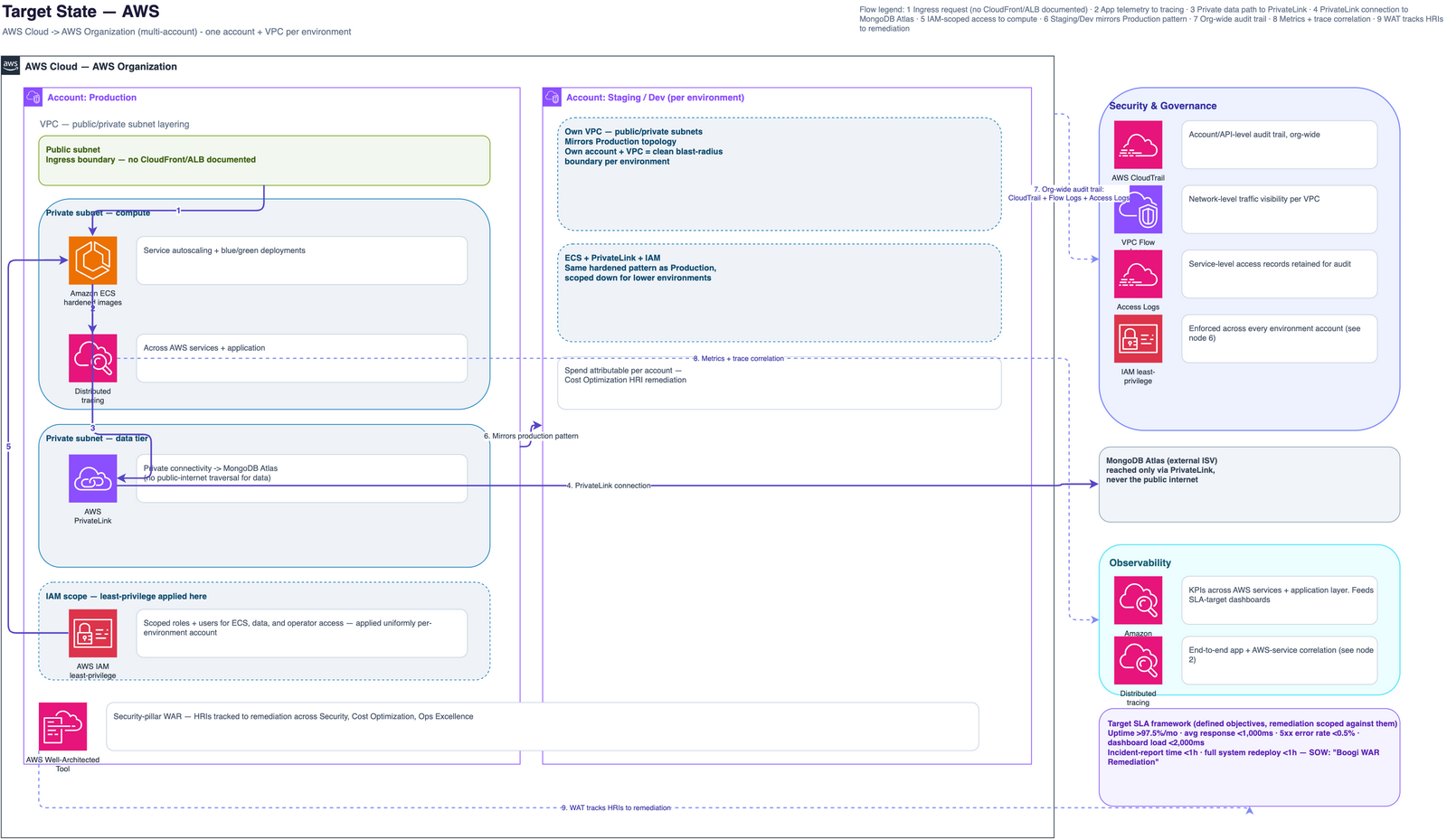
Ahead of a fintech raise, VeUP ran a Security-pillar AWS Well-Architected Review for Boogi Technologies and designed a security-first remediation: a multi-account AWS Organization with per-environment VPC isolation, least-privilege IAM, PrivateLink to MongoDB Atlas, and hardened ECS — to defined SLAs.
The challenge
Boogi was scaling fast and needed to be sure its AWS foundation could carry the growth — and stand up to the scrutiny that comes with a fintech raise. The trigger was a security-focused architecture validation: before committing the next round of infrastructure investment, the team wanted an independent, structured assessment of where the real risks were and a concrete plan to close them. For a financial-services platform the bar is high — account isolation, least-privilege access, private connectivity to sensitive data stores, audit-grade logging, and defined, measurable service-level targets — all designed and prioritized, not just listed.
The solution
A full AWS Well-Architected Review (WAR) centered on the Security pillar, surfacing high-risk items across Security, Cost Optimization, and Operational Excellence, translated into a hands-on remediation design with a security-first, multi-account architecture. Account isolation by design: an AWS Organization with each environment split into its own account and VPC for clean blast-radius boundaries. Network and identity hardening: public/private subnet layering, least-privilege IAM for users and roles, and private connectivity to MongoDB Atlas (AWS PrivateLink) so sensitive data never traversed the public internet. Container and delivery hardening: container-image hardening, Amazon ECS service auto-scaling, and blue/green deployments for ECS tasks. Audit-grade observability: AWS CloudTrail, VPC Flow Logs, access logs, Amazon CloudWatch KPIs across AWS services and the application, and distributed end-to-end tracing. The remediation was scoped against explicit, measurable SLA targets.
Production outcomes
| KPI | Result |
|---|---|
| Production outcomes | The Well-Architected Review put names on the real risks — high-risk items across Security, Cost Optimization, and Operational Excellence. VeUP answered with a security-first, multi-account design: per-environment account and VPC isolation, least-privilege IAM, PrivateLink to the data store, hardened ECS with blue/green deployments and autoscaling, and CloudTrail, VPC Flow Logs, and CloudWatch observability. And the target posture is measurable: monthly uptime above 97.5%, average response under 1,000 ms, 5xx errors under 0.5%, dashboards loading in under 2,000 ms, incident reports within the hour, a full redeploy in under an hour. |
| Engagement window | The platform has run with VeUP since September 2024. The security-pillar review followed, the remediation design and SLA framework are in Boogi's hands, and the work continues. |
| Cost / TCO posture | The review surfaced cost-optimization risks alongside the security findings — and both fold into the same multi-account design: per-environment isolation makes spend attributable, account by account. |
| Lessons & continuation | For a fintech preparing to raise, account isolation by design (one account + VPC per environment) is the highest-leverage move — it gives clean blast-radius boundaries and makes both security and cost attributable. The SLA figures are honest targets: the design defines the posture, and the live platform proves it. |
 Amazon VPC
 AWS IAM
 VPC Flow Logs
 Amazon CloudWatch
 AWS Well-Architected Tool
Architecture
From a single shared account to clean per-environment isolation — the gaps the security review uncovered, and the target multi-account design that closes them.
Where it started
Assessed baseline · Well-Architected ReviewSingle AWS account · Full six-pillar review, 2024Dev, staging, and production shared a single AWS account and one blast-radius boundary.
Public and private workloads were not cleanly layered — no per-subnet public/private separation, no environment isolation.
Users and roles were not scoped to least privilege — a Security-pillar high-risk finding, later remediated with a least-privilege IAM redesign.
MongoDB Atlas was reachable over the public internet — no PrivateLink.
ECS tasks ran without image hardening, autoscaling, or blue/green deploys; no CloudTrail or VPC Flow Logs baseline and no unified CloudWatch KPIs.
The baseline as assessed by the 2024 AWS Well-Architected Review, before the remediation program.
What the review surfaced, pillar by pillar.
- High-risk issue remediated via blue/green ECS deploys
- Distributed tracing added
- Terraform IaC with CI/CD delivery
- The review's center of gravity
- Least-privilege IAM and a PrivateLink data path
- Per-environment account isolation
- CloudTrail, Flow Logs, access logs — a full audit trail
- ECS autoscaling with blue/green deploys
- Targets: >97.5% uptime, <0.5% errors
- Per-environment isolation limits blast radius
- Targets: responses under 1s, dashboards under 2s
- CloudWatch KPIs give a measurable tuning baseline
- High-risk pillar, folded into the multi-account design
- Per-environment isolation makes spend attributable by account