

BrontoBytes runs 4-5 TB/day per customer on AWS Lambda + Kinesis Firehose
 AWS Lambda
 Amazon Kinesis Firehose
 Amazon S3
 Amazon MSK
For BrontoBytes — a multi-tenant log-analytics SaaS ingesting ~4-5 TB/day per customer — VeUP delivered a Well-Architected modernization: Kinesis Firehose ingestion into an S3 log store, hundreds of GraalVM Lambdas for burst search, and a FinOps target of a 30-40% per-search Lambda cost cut.
The challenge
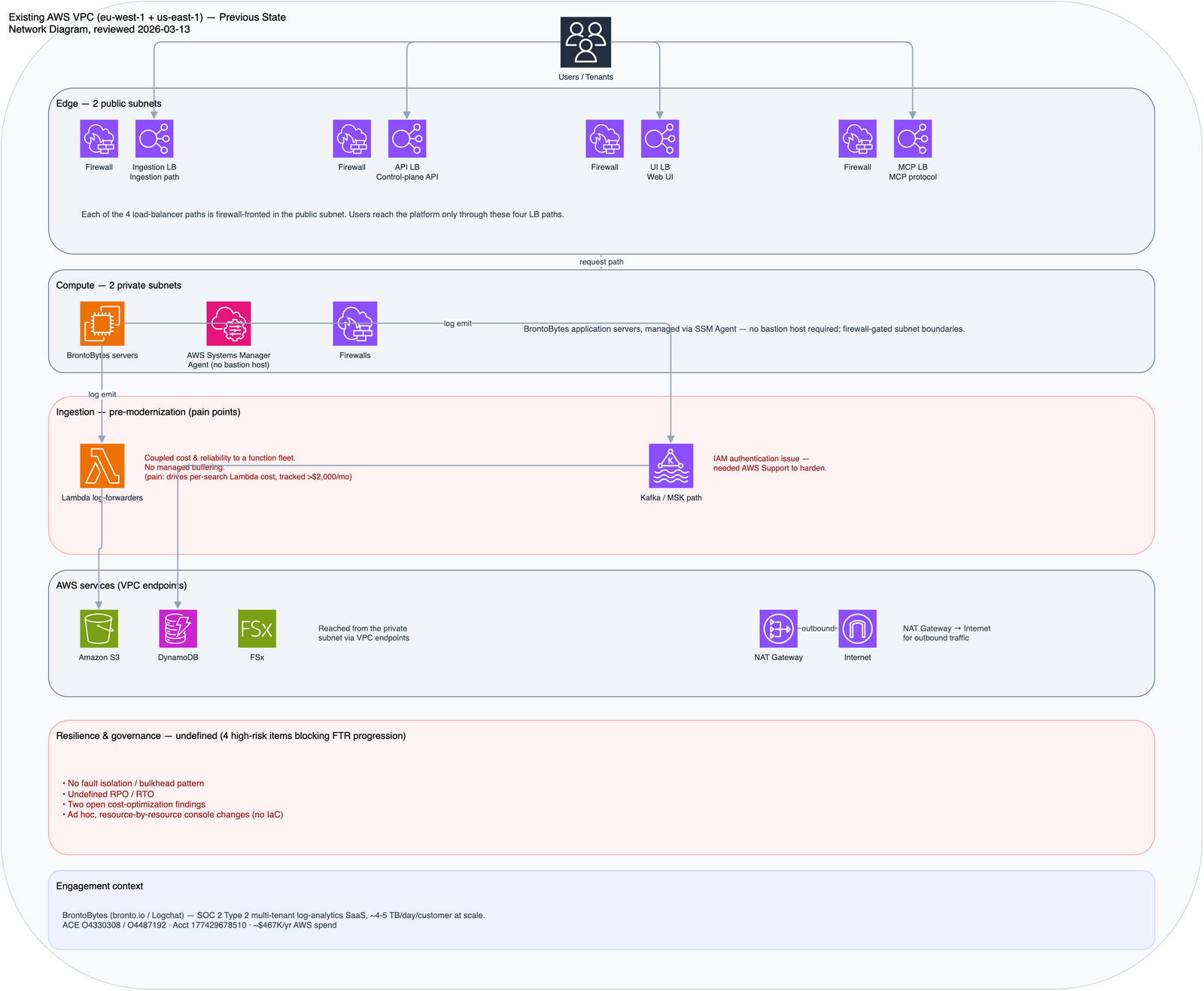
The customer operates a multi-tenant log-visualization-and-analytics SaaS that ingests, stores, and queries customer log data in real time at ~4-5 TB/day per customer at scale. Its ingestion ran on a Lambda log-forwarder path that coupled cost and reliability to a function fleet and lacked managed buffering; burst search over the data is spiky and embarrassingly parallel, so per-search Lambda cost was a growing margin driver; and a Well-Architected gap analysis was needed to clear a Foundational Technical Review (FTR).
The solution
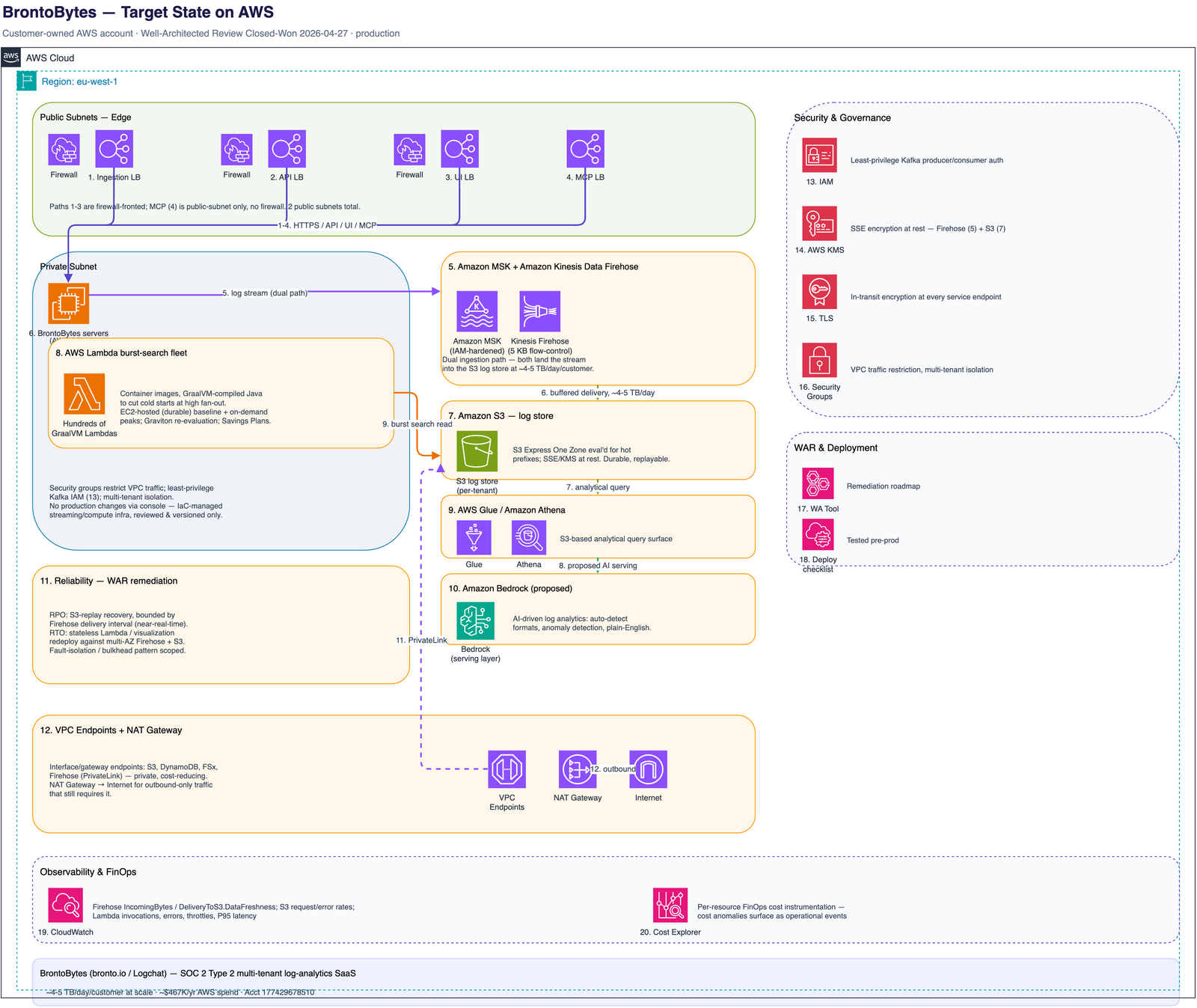
A Well-Architected modernization of a TB/day log-analytics pipeline: Amazon Kinesis Data Firehose ingestion (buffered, flow-controlled) into an Amazon S3 log store (per-tenant partitioning), over which hundreds of parallel AWS Lambda functions — GraalVM-compiled Java in container images to minimize cold starts at high fan-out — run burst searches feeding real-time visualization, with Amazon MSK (managed Kafka, IAM-auth resolved with AWS Support) in the ingest path and a proposed Amazon Bedrock serving layer for AI-driven log analytics. FinOps layered a hybrid baseline (EC2-hosted Lambda + Savings Plans) plus on-demand peak design and a Graviton re-evaluation. Every big fork went the cost-defensible way: S3 over a warehouse, Lambda fan-out over an always-on cluster, Firehose over the old log-forwarder.
Architecture
The ingestion-and-search estate — from the pre-modernization Lambda log-forwarder path to the production Kinesis Firehose + Amazon MSK ingestion, the Amazon S3 log store, and the Lambda burst-search fan-out.
Production outcomes
| KPI | Result |
|---|---|
| Production outcomes | Ingestion moved off the Lambda log-forwarder path onto Amazon Kinesis Data Firehose — buffered, flow-controlled, and billing-increment-aware at multi-TB/day. The Well-Architected roadmap closes four high-risk items: fault isolation, undefined RPO/RTO, and two cost-optimization findings. And the FinOps target is a 30-40% cut in per-search Lambda cost with no P95-latency regression. |
| Engagement window | The engagement opened with an Art-of-the-Possible session in March 2026; the Well-Architected review followed in April, and the modernization work is ongoing. |
| Cost / TCO posture | Per-search unit economics is the platform-margin lever: a 30-40% cut in per-search Lambda cost, held to a P95-latency guardrail, via a hybrid EC2-hosted-Lambda + Savings Plans baseline, on-demand peak design, and a Graviton re-evaluation. Firehose flow-control aligns records to the 5 KB billing increment so ingestion cost stays honest at TB/day. |
| Lessons & continuation | At TB/day, S3 over a warehouse and Lambda fan-out over an always-on cluster are the cost-defensible choices (pay-per-search vs idle capacity); Firehose ingestion must be flow-controlled to the 5 KB billing increment or cost inflates; the per-search cost-down needs a P95-latency guardrail so margin gains can't degrade the product; the managed-Kafka/MSK IAM-auth path needed AWS Support to harden. |
 Amazon Bedrock (proposed)
 AWS Cost Explorer
 AWS Savings Plans
 AWS Well-Architected Tool
 AWS Graviton