An energy-sector fibre-optic-sensing technology company
AWS-validated reference — full details available to AWS Partner Validation or on request. (Customer name held on file with VeUP.)
For the customer fibre-optic-sensing workload monitoring critical energy infrastructure, VeUP ran a full AWS Well-Architected Framework Review — 57 questions, 43 high-risk and 14 medium-risk findings — into a customer-accepted Top-5 roadmap, an AWS Control Tower landing-zone proposal, and a Cost Deep Dive surfacing ~$700/mo of savings.
The challenge
the customer runs a fibre-optic-sensing workload on AWS that grew up in a single account and a single Region. Production, staging, and development shared one AWS account and VPC with overlapping CIDR ranges and no traffic inspection; there was no disaster-recovery plan and data lived in one Region with no replication or S3 backups; monitoring was reactive (the team often learned of problems from client complaints); components were tightly coupled with no auto-scaling; and encryption, data-classification, and least-privilege controls had gaps. The company needed a clear-eyed assessment and a prioritized plan to mature its operations without over-spending.
The solution
A comprehensive AWS Well-Architected Framework Review of the customer entire AWS estate — 57 questions answered, surfacing 43 high-risk and 14 medium-risk issues — distilled into Top-5 Strategic Priorities: isolate environments and secure the network boundary; establish disaster recovery and encrypted backups; add proactive monitoring and a formal incident-response framework; build workload resilience and high availability through loose coupling and auto-scaling; and enforce data protection with centralized identity, least privilege, and an encryption mandate. To execute the isolation priority, VeUP proposed an AWS Control Tower landing zone for multi-account governance, separating prod/staging/dev into dedicated accounts and discrete VPCs to shrink the blast radius. A Cost Optimization Deep Dive reviewed Savings Plans coverage gaps on T-class/CPU-credit instances, right-sizing of P3 (GPU) instances used for an MLOps experimentation environment, Amazon S3 Intelligent-Tiering, snapshot hygiene, and outbound-traffic economics — including moving data-out through Amazon CloudFront rather than direct egress.
Production outcomes
| KPI | Result |
|---|---|
| Production outcomes | A complete Well-Architected Framework Review — 57 questions answered, 43 high-risk and 14 medium-risk findings — distilled into a Top-5 remediation roadmap that the customer accepted; an AWS Control Tower landing-zone proposal to establish multi-account isolation and governance; and a Cost Optimization Deep Dive that surfaced an estimated ~$700/month saving by routing outbound traffic through Amazon CloudFront instead of direct egress, plus per-instance right-sizing and S3 Intelligent-Tiering reductions. Green account health was maintained through the engagement. |
| Engagement window | 2025-11 (Ignite advisory cadence began); WAFR Executive Summary Feb 2026 → WAFR delivered (57 Qs; 43 high / 14 medium) + Top-5 roadmap accepted + Control Tower proposal + Cost Deep Dive (closed 2026-02-25); ongoing |
| Cost / TCO posture | The Cost Optimization Deep Dive surfaced ~$700/month from a CloudFront-vs-direct outbound-traffic move (CloudFront materially cheaper data-out), plus per-instance right-sizing (e.g. ~$0.50/day per instance moving off T-class to an M6a instance), Savings Plans coverage gaps on CPU-credit/T3 instances, P3 (GPU) right-sizing for the MLOps environment, and S3 Intelligent-Tiering reductions. Itemized estimates from the deep dive, not a single realized post-implementation savings figure. |
| Lessons & continuation | For a workload that grew up in one account and one Region, the highest-leverage move is environment isolation via a Control Tower landing zone (dedicated prod/staging/dev accounts and VPCs) to shrink the blast radius. The cost figures are itemized estimates from the deep dive; which Top-5 remediations are now implemented and a realized total saving are tracked with the customer. |
AWS Control Tower · AWS Well-Architected Tool · Amazon EC2 · Amazon RDS · Amazon S3 (Intelligent-Tiering) · Amazon CloudFront · AWS Savings Plans
Architecture
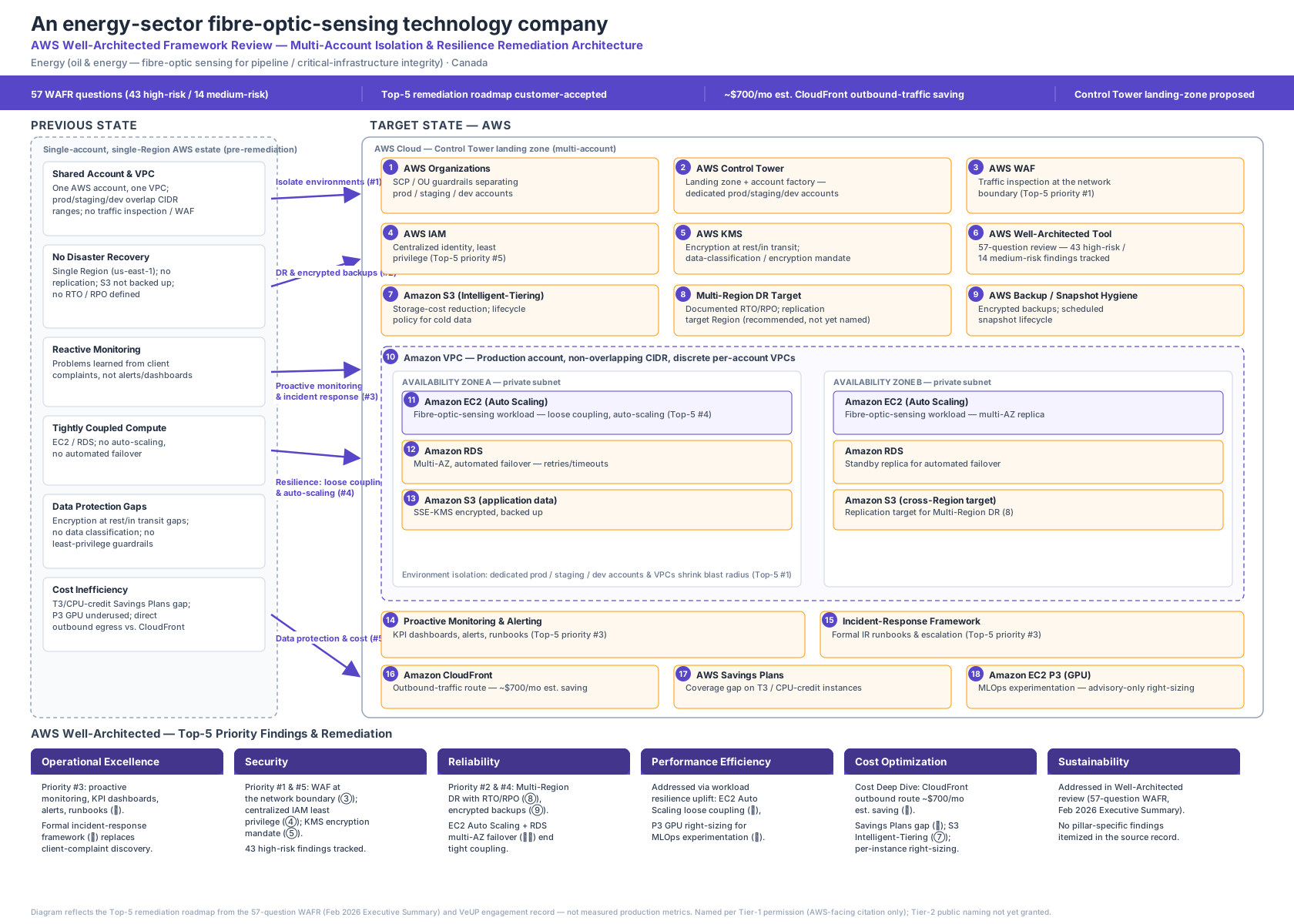
The WAFR's Top-5 remediation target-state architecture: an AWS Control Tower landing zone separating prod/staging/dev into dedicated accounts and VPCs, with centralized IAM least privilege, KMS encryption, Multi-Region DR and encrypted backups, EC2 Auto Scaling with RDS multi-AZ failover, proactive monitoring and incident response, and the Cost Optimization Deep Dive's CloudFront, Savings Plans, and S3 Intelligent-Tiering moves — annotated against all six WAFR pillars.