

MyCena hardens its AI agents with Anthropic Claude on Amazon Bedrock
 Amazon Bedrock
VeUP advised MyCena Security Solutions, a credential-security ISV, through a production agentic build on Amazon Bedrock — Bedrock Agents + Knowledge Bases RAG + Guardrails on Anthropic Claude (3.5 Sonnet → Haiku). Guardrails enforce prompt-injection protection; a benchmarked Haiku/Sonnet/Nova selection powers it.
The challenge
MyCena set out to add conversational AI to a security product — the category where the trust bar is highest. It needed AI agents that could answer customer product questions with session continuity and drive an interactive onboarding flow (creating users and credentials directly in the admin console) without becoming a new attack surface. For a credential-security vendor, prompt-injection resistance and a defensible model-selection rationale were not optional, and latency-sensitive steps run in the user's path so the agents had to stay fast and cost-controlled.
The solution
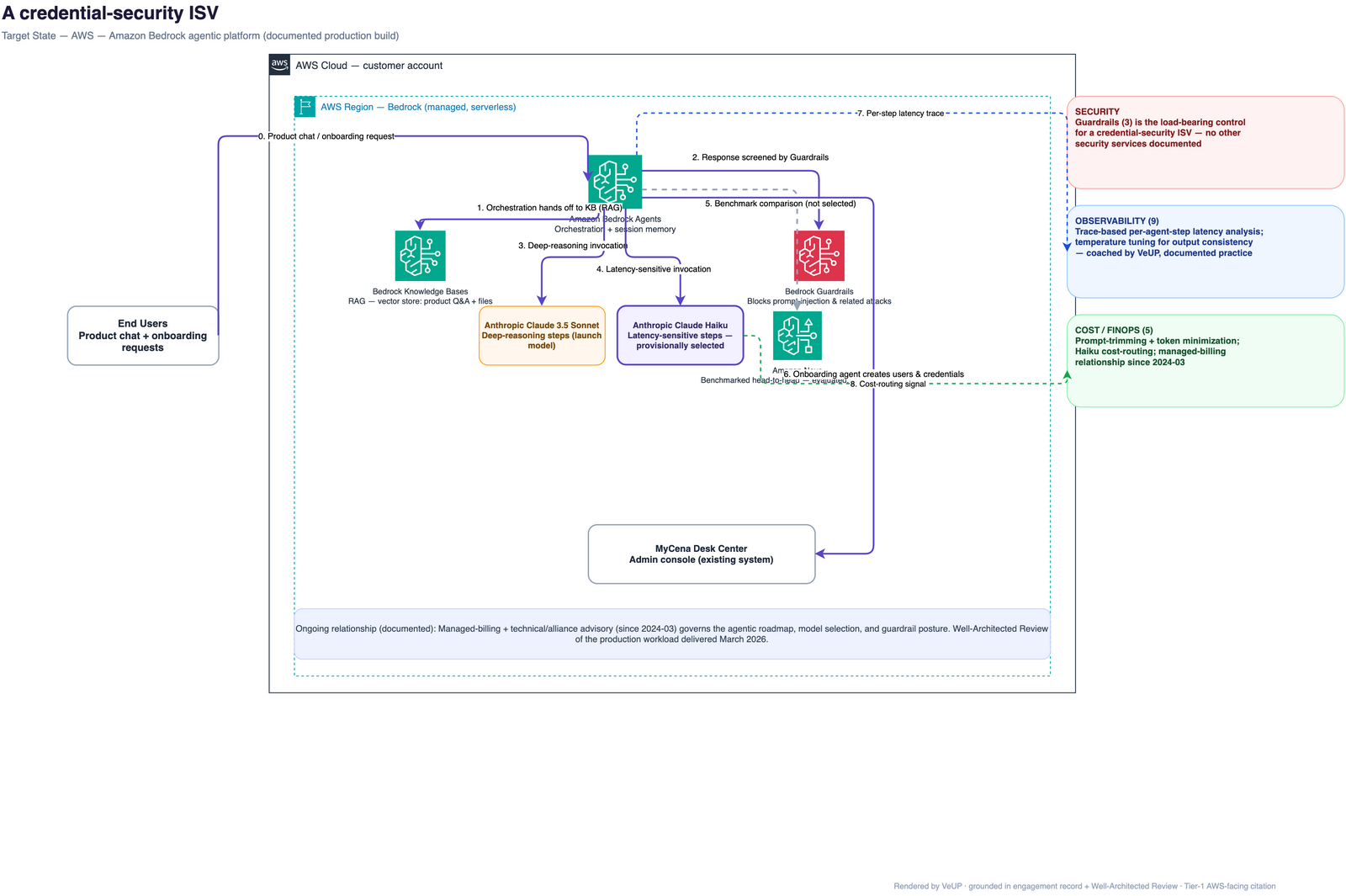
VeUP advised MyCena hands-on through a production agentic build on Amazon Bedrock, using Bedrock Agents to orchestrate a multi-step flow — session memory, Bedrock Knowledge Bases for retrieval-augmented generation over a vector store of product Q&A and files, response generation, and output streaming. Amazon Bedrock Guardrails were configured to block prompt-injection and related attacks — the load-bearing control for a security ISV. The agents launched on Anthropic Claude 3.5 Sonnet; VeUP advised moving latency-sensitive steps to Claude Haiku (faster, cheaper) while reserving Sonnet for deep-reasoning steps. MyCena built three agents on three models to compare head-to-head — including a benchmark against Amazon Nova — and provisionally selected Haiku, tuned through system instructions. VeUP coached on prompt-trimming and token minimization, temperature settings, and trace-based per-step latency analysis. Two agents are in active development: an AI product-question chatbot with session continuity, and an onboarding agent that operates the admin console rather than emitting static templates.
Production outcomes
| KPI | Result |
|---|---|
| Production outcomes | MyCena runs Claude-on-Bedrock agents with guardrail-enforced prompt-injection protection and a benchmarked model-selection rationale (Haiku for latency-sensitive paths, Sonnet for deeper reasoning), arrived at by comparing three live agents on three models. VeUP delivered a Well-Architected Review of the production workload (March 2026) and runs an ongoing managed-billing and technical/alliance advisory relationship governing the agentic roadmap, model selection, and guardrail posture. Per-agent latency and cost figures are still early-stage — shared on request rather than published. |
| Engagement window | VeUP has run MyCena’s managed-billing relationship since March 2024. The agentic build advisory ran through 2025, the Well-Architected Review landed in March 2026, and both the build and the advisory continue. |
| Cost / TCO posture | Managed-billing / FinOps relationship governs cost; VeUP coached on token minimization (prompt-trimming) and model cost-routing (Haiku for latency-sensitive steps, Sonnet reserved for deep reasoning) as the primary agent-cost levers. Per-agent cost figures are still early-stage and not yet published. |
| Lessons & continuation | For a credential-security ISV, Bedrock Guardrails prompt-injection hardening is the load-bearing control and must be designed before the agent ships; a three-agent / three-model head-to-head is the defensible way to choose between Claude tiers and Amazon Nova; reserve the deep-reasoning model for the steps that need it and route latency-sensitive steps to the cheaper/faster model. |
 Anthropic Claude 3.5 Sonnet
Architecture
A net-new agentic AI build on the existing MyCena Desk Center console: Amazon Bedrock Agents orchestrate session memory, Bedrock Knowledge Bases retrieval-augmented generation, and Bedrock Guardrails prompt-injection protection over a benchmarked Claude 3.5 Sonnet / Claude Haiku / Amazon Nova selection.
Where it started
Assessed baseline · new implementationSoftware & Internet — credential / access-security ISV · United KingdomThe MyCena Desk Center admin console — user and system management with encrypted credential distribution — already in production on AWS.
Static templates only: admins manually created users and credentials, with no interactive admin-console automation.
No AI agents in production — every product question and onboarding interaction was manual or static-template, with customers self-serving via docs.
Conversational AI could not ship without a hardened, load-bearing prompt-injection defense.
No head-to-head benchmark for which model tier fits which step, and no tracing or cost-routing on latency-sensitive paths.
Net-new agentic features layered onto an existing product — not an infrastructure migration; the platform itself was already live on AWS.