
A credit union migrates an ~800 GB core-banking database to AWS under a phased, tested cutover
 Amazon ECS / Fargate
 Amazon RDS
 AWS Glue
 GuardDuty + Security Hub
Anonymized production engagement — the customer’s name is held on file with VeUP and available on request.
VeUP ran a six-pillar AWS Well-Architected Review for a regulated U.S. credit union, prioritized five HIGH-risk findings into a phased 90-day remediation roadmap, stood up a Security Accelerator foundation, and delivered the migration of its Jack Henry core-banking SQL Server database into AWS — inside a phased migration program with backup and DR configuration, source-to-target reconciliation, and tested restores ahead of cutover.
Business impact
The challenge
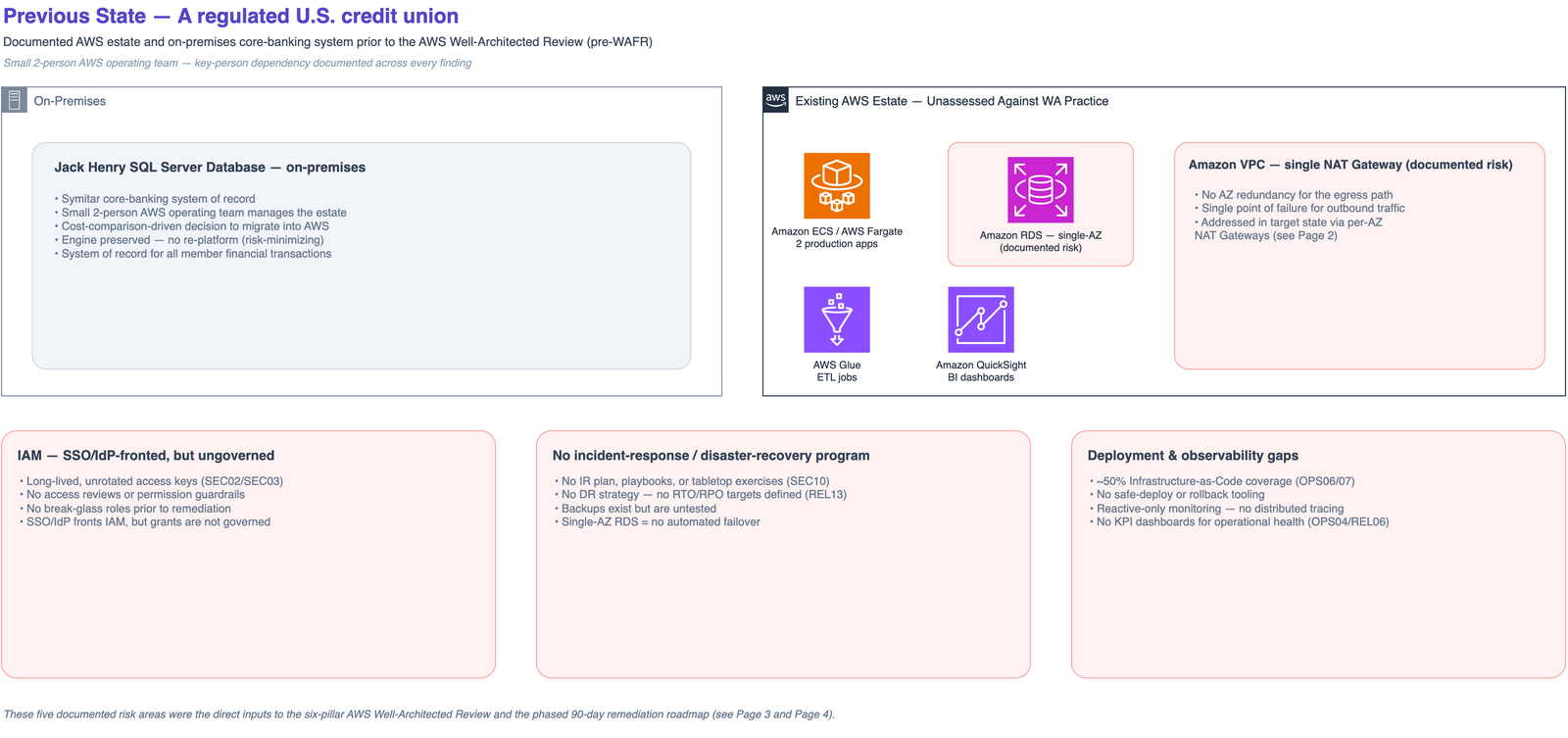
The customer is a member-owned U.S. credit union regulated under NCUA Part 748 and its Appendix A safeguards, the FFIEC IT Examination Handbook, and the GLBA Safeguards Rule, serving members through always-on digital and core-banking channels. The production estate behind those channels ran on aging on-premises infrastructure: a Microsoft SQL Server 2016 core database platform on a 16-core blade carrying a production database of roughly 800 GB, the Jack Henry core-banking system databases, a custom-application database, and SSIS (data integration) and SSRS (reporting) running on the same platform — with analytics users querying the production OLTP database directly, contending with the member-facing workload. An imminent SQL Server Enterprise license renewal and a looming hardware refresh made the on-premises status quo an expensive default.
Alongside the on-premises core, the credit union already ran a growing AWS estate — two production applications on Amazon ECS with AWS Fargate, a relational tier on Amazon RDS, scaled AWS Glue ETL, Amazon QuickSight, and a Terraform-deployed data lake — sitting in us-west-1 with multi-region transit-gateway complexity and three separate CloudTrail trails. That estate had grown without an independent, framework-driven assessment, and with only two people actively managing AWS the institution carried key-person dependency and limited capacity to formalize incident response, disaster recovery, and operational readiness. For a financial institution handling member financial data, undocumented gaps in IR, DR, and observability are compliance and member-trust exposure, not just technical debt.
The engagement
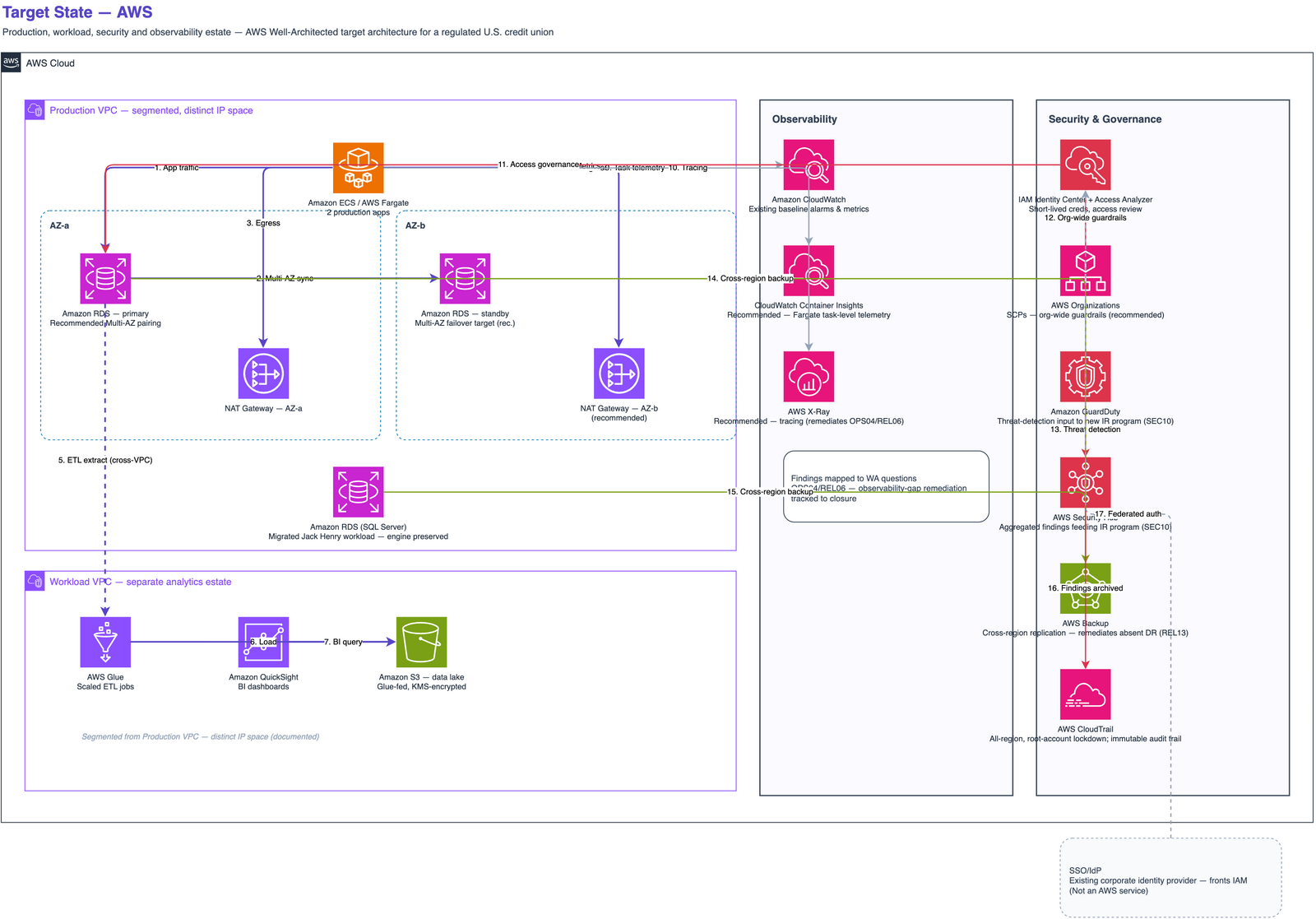
VeUP ran a full AWS Well-Architected Framework Review across all six pillars as a structured, multi-session engagement using the AWS Well-Architected Tool question set, producing an executive findings report and a phased 90-day remediation roadmap sequenced into Immediate (0–30 days), Short-term (30–60 days), and Medium-term (60–90 days) workstreams. The review prioritized five HIGH-risk findings — no incident-response program, an absent disaster-recovery strategy, IAM deficiencies, deployment and operational-readiness gaps, and insufficient observability — each mapped to a specific Well-Architected question and a concrete AWS-native remediation. Off the back of the review, VeUP delivered a 3-tier Security Accelerator, with Tier 1 establishing the security foundation: an Incident Response Plan aligned to NIST SP 800-61, break-glass IAM roles, annual tabletop exercises, and Amazon GuardDuty plus AWS Security Hub enablement.
In parallel, VeUP scoped and delivered the migration of the credit union’s Jack Henry core-banking SQL Server database into AWS — a cost-comparison-driven move, executed as part of a wider phased migration of the on-premises estate. The migration program follows a single architecture of record — agreed with the customer in February 2026 and pressure-tested in the March Well-Architected Review: the core SQL Server platform replatforms from SQL Server 2016 Enterprise to the AWS license-included SQL Server 2022 Standard AMI on Amazon EC2, while the Jack Henry core-banking databases rehost to EC2 with minimal change and real-time connectivity preserved over an encrypted site-to-site VPN, coordinated with Jack Henry. Amazon RDS was evaluated for the core platform and deliberately not selected — SSIS and SSRS require the full, self-managed SQL Server feature set that a managed database service does not expose in the form this estate needs — a deliberate platform call that keeps the regulated core stable while still capturing the licensing, right-sizing, and governance benefits of the move.
Migration approach
Discovery and assessment ran as a structured readiness engagement built on the AWS Cloud Adoption Framework and the Well-Architected Review. All six CAF perspectives — Business, People, Governance, Platform, Security, and Operations — were scored current-versus-target and walked through with the customer: where the institution stood, where the gaps were, and what to do about them. Every workload got a 7Rs disposition; every risk, a quantified place on the heat map; every recovery objective, a tier. Controls were mapped first to NIST CSF, CIS, and the Well-Architected Security pillar, then to the rules a credit union answers to: NCUA Part 748 and Appendix A, FFIEC, and the GLBA Safeguards Rule. The readiness verdict was explicit: ready to migrate under a phased plan, once the flagged governance and security items closed before cutover.
Pre-cutover mobilization closes those items: a separate, locked-down production AWS account where deployment happens only through Terraform and the CI/CD pipeline — no console access — so every production change is code-reviewed, version-controlled, and auditable; privileged access vaulted and brokered through CyberArk with session recording and a documented break-glass procedure; AWS IAM Identity Center for centralized, role-based least-privilege access federated to the institution’s identity provider; AWS KMS encryption at rest and TLS in transit, including the VPN paths; CloudTrail consolidated from three trails to one centralized trail delivered to a dedicated, access-restricted, encrypted log-archive bucket with log-file validation; AWS Config across the estate for continuous drift detection and board-reportable control evidence; and end-to-end validation of the Jack Henry site-to-site VPN. Because the no-console operating model is a genuine workflow change for a two-person cloud team, VeUP stands up a Terraform mock dev/staging environment where the customer’s team practices provisioning and operations before touching production, backed by a multi-AZ disaster-recovery drill against the tiered recovery objectives.
Cutover is phased: backup and DR configuration and testing come ahead of cutover, the roughly 800 GB data migration is reconciled source-to-target with integrity checks and tested restores from Amazon S3, and the engagement closes through formal acceptance. Modernization is deliberately sequenced after the migration is stable: the SSIS/SSRS pipeline refactors to AWS Glue and AWS Step Functions with Amazon QuickSight on a proven base — the right order of operations for a regulated, always-on banking estate.
Workloads and scope
| Workload | Disposition | Landing on AWS |
|---|---|---|
| Core SQL Server 2016 platform (~800 GB production database) | Replatform | SQL Server on Amazon EC2 (r5 family), AWS license-included SQL Server 2022 Standard AMI, right-sized 16 → 8 cores |
| Jack Henry core-banking databases | Rehost | Amazon EC2, minimal change to the regulated core; real-time connectivity preserved over an encrypted site-to-site VPN coordinated with Jack Henry |
| Custom-application database | Rehost | SQL Server on Amazon EC2, preserving application compatibility while capturing region, cost, and governance benefits |
| SSIS / SSRS data-integration and reporting pipeline | Retain, then refactor | Retained at cutover; Phase-2 refactor to AWS Glue and AWS Step Functions with Amazon QuickSight |
| Analytics access | Repurchase / refactor | Moved off the production OLTP database onto an Amazon S3 data lake with Amazon QuickSight, removing reporting contention from the member-facing system |
| Database backups | Re-platform to cloud-native | Amazon S3 — encrypted, versioned, off-host, with tested restores and point-in-time recovery |
| Existing AWS footprint (Terraform-deployed data lake and network) | Relocate / rationalize | us-west-1 → us-west-2; multi-region transit gateway collapsed to single-region VPC peering; three CloudTrail trails consolidated to one |
| On-premises blade and SQL Server Enterprise licensing | Retire | Hardware-refresh cycle and the pending Enterprise license renewal retired with the platform |
Well-Architected posture
The engagement’s posture maps directly onto the six Well-Architected pillars. Operational Excellence: deployment and operational-readiness gaps (OPS06/OPS07) close through the Terraform/pipeline-only production model, mock-environment team enablement, and runbooks drilled before steady state; observability gaps (OPS04/REL06) route to Amazon CloudWatch with Container Insights and AWS X-Ray. Security: the absent incident-response program (SEC10) is remediated with a NIST SP 800-61-aligned IR plan; IAM deficiencies (SEC02/SEC03) with AWS IAM Identity Center, break-glass roles, and CyberArk-brokered privileged access; threat detection with Amazon GuardDuty and AWS Security Hub; and encryption standardized on AWS KMS at rest and TLS in transit. Reliability: the absent DR strategy (REL13) and the single-AZ and single-NAT-Gateway risks the review surfaced convert into multi-AZ deployment for the core tier, tiered RTO/RPO objectives, AWS Backup with cross-region replication, and a rehearsed DR drill. Performance Efficiency: compute is sized against the measured workload rather than carried-forward hardware, validated on the r5 instance family with pipeline-controlled headroom to scale. Cost Optimization: the licensing step-down to license-included SQL Server Standard, the region relocation, transit-gateway collapse, and CloudTrail consolidation all cut standing cost, with AWS Budgets and AWS Cost Anomaly Detection standing guard on the production account. Sustainability: right-sizing an over-provisioned 16-core blade down to 8 cores reduces the estate’s standing footprint alongside its cost.
Architecture
Outcomes
| KPI | Result |
|---|---|
| Well-Architected Review | Full six-pillar review delivered; five HIGH-risk findings identified and prioritized, each mapped to specific WA questions — SEC10 (no IR program), REL13 (absent DR strategy), SEC02/SEC03 (IAM deficiencies), OPS06/OPS07 (deployment & operational-readiness gaps), OPS04/REL06 (insufficient observability) — with concrete AWS-native remediations. |
| Remediation roadmap | The review’s architecture risks — single-AZ RDS, a single NAT Gateway, ~50% IaC coverage, reactive-only monitoring — became a phased 90-day backlog: Immediate (0–30), Short-term (30–60), Medium-term (60–90 days). |
| Security Accelerator | 3-tier Security Accelerator delivered with Tier 1 — the highest-priority security foundation: NIST SP 800-61-aligned Incident Response Plan, break-glass IAM roles, GuardDuty and Security Hub enablement — live, establishing the base for phases 2 and 3. |
| Core-banking database migration | Jack Henry SQL Server core-banking database migration delivered into AWS — a cost-comparison-driven rehost to Amazon EC2 that keeps change to a minimum on the regulated core, with real-time connectivity preserved over an encrypted site-to-site VPN and the ~800 GB migration reconciled source-to-target with tested restores. |
| Cost levers | Every lever pulls against the on-premises baseline: SQL Server Enterprise license renewal avoided via the license-included SQL Server 2022 Standard AMI on EC2; compute right-sized 16 → 8 cores; region consolidation us-west-1 → us-west-2; multi-region transit gateway collapsed to single-region VPC peering; CloudTrail trails consolidated 3 → 1; AWS Budgets and Cost Anomaly Detection standing guard on the production account. |
| Engagement window | Onboarded in January 2026, architecture of record agreed in February, and the full Well-Architected Review run through March, with the executive report landing in late March. Security Accelerator Tier 1 went live from April; the Jack Henry database migration was delivered in 2026; and the phased migration program continues toward full cutover. |
| Lessons & continuation | For a small-team regulated institution, the highest-leverage outputs are a sequenced 90-day roadmap that starts with credential rotation, AWS Backup cross-region replication, and GuardDuty/Security Hub enablement — and a cutover governed by gates rather than a calendar date. Mapping every finding to a specific WA question and a NIST SP 800-61-aligned IR plan makes the risk posture defensible to regulators; remaining migration waves and the Phase-2 SSIS/SSRS modernization to Glue, Step Functions, and QuickSight continue on that base. |
 AWS Well-Architected Tool
 Amazon EC2 (SQL Server license-included)
 Amazon QuickSight
 Amazon S3
 Amazon VPC + NAT Gateway
 AWS Site-to-Site VPN
 AWS Security Hub
 AWS Backup
 AWS IAM Identity Center
 IAM Access Analyzer
 AWS Organizations
 AWS KMS
 AWS CloudTrail
 AWS Config
 Amazon CloudWatch + Container Insights
 AWS X-Ray
 AWS Budgets
 AWS Step Functions (Phase-2 modernization)