

SalesNOW designs a tenant-isolated AI assistant with Claude on Amazon Bedrock
 Amazon Bedrock
 Anthropic Claude
VeUP designed an in-app AI assistant for SalesNOW, the multi-tenant cloud + mobile CRM from Interchange Solutions Inc., on Amazon Bedrock with Anthropic Claude — a tenant-isolated agent answering natural-language pipeline questions read-only via MCP tool calls over existing REST APIs, plus Smart Reply. Strict per-tenant, human-in-the-loop v1.
The challenge
Interchange Solutions wanted to put AI directly inside its SalesNOW CRM rather than bolt on an external tool: let users ask natural-language questions about their own pipeline and accounts, and suggest context-aware replies to customers in the app. As a multi-tenant SaaS, the hard requirement was strict tenant isolation — no query, suggestion, or answer could ever cross a tenant, team, or user boundary — and the assistant had to read from SalesNOW's existing backend as the single source of truth rather than stand up a new live database. It needed a foundation model with strong reasoning and tool-use on infrastructure it already trusted.
The solution
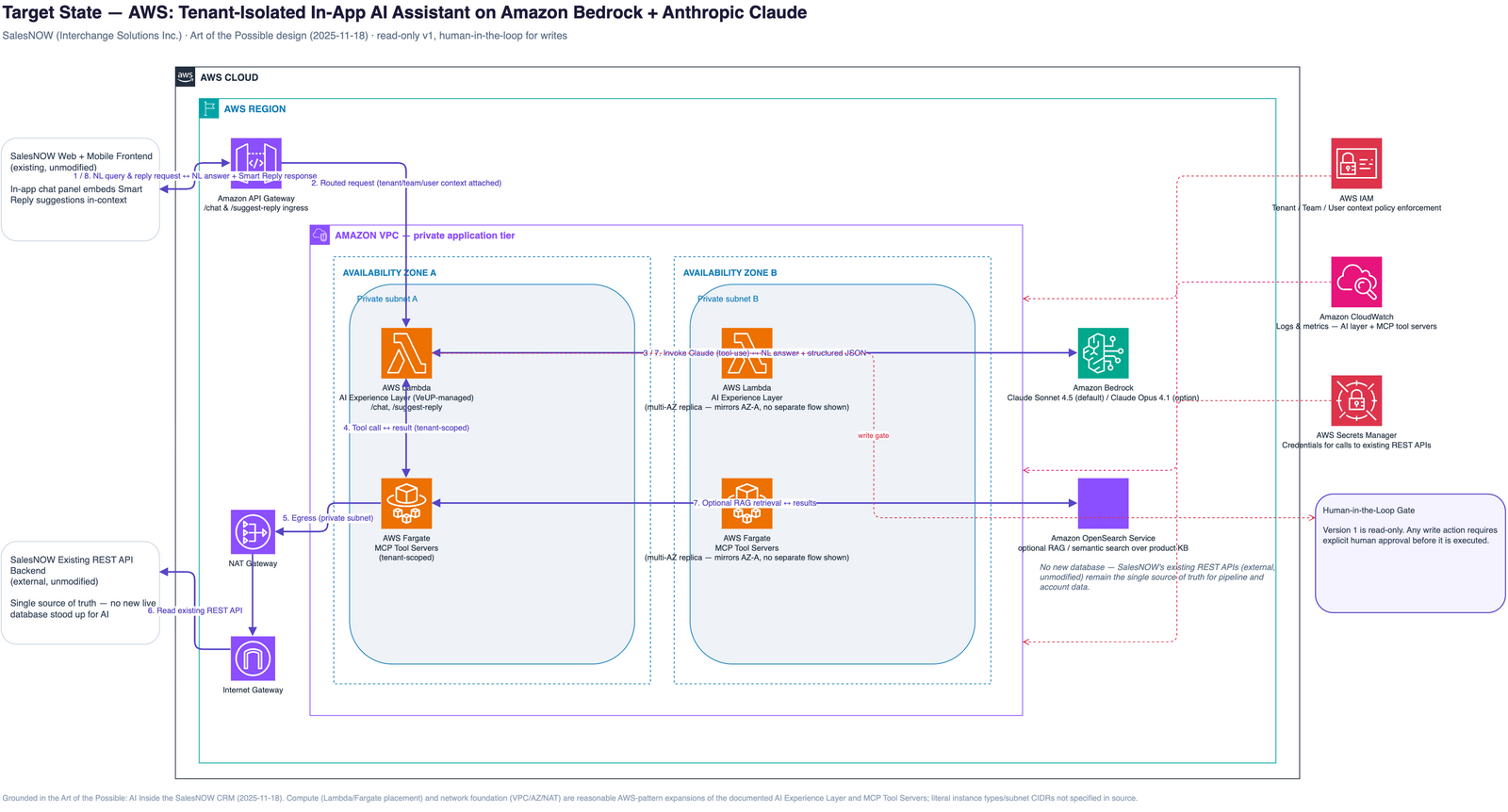
An in-app AI experience layer on Amazon Bedrock with Anthropic Claude as the foundation model. The architecture exposes /chat and /suggest-reply endpoints backed by a tool/data-access layer of Model Context Protocol (MCP) servers that wrap SalesNOW's existing REST APIs, with optional retrieval-augmented search over the product knowledge base. Tenant, team, and user context propagates through every layer so each query is constrained to the caller's own data. Version 1 is read-only with human-in-the-loop for any writes, and the chat panel lives inside SalesNOW rather than as a separate product. VeUP named Claude Sonnet 4.5 and Claude Opus 4.1 as the model options (backed by Sonnet 4.5), drawing on Bedrock's multi-provider catalog while standardizing on Claude for reasoning and tool-calling. Two priority use cases anchor the build: a tenant-aware analytics chatbot that answers read-only pipeline and account questions through existing-API tool calls (natural-language summaries, optional structured JSON), and Smart Reply — context-aware suggestions for customer replies.
Production outcomes
| KPI | Result |
|---|---|
| Production outcomes | SalesNOW now has a tenant-isolated agentic design on Bedrock and Claude: an agent that selects tools and composes answers over the customer's own data, strictly scoped per tenant, read-only with a human in the loop for v1. VeUP runs the live AWS resell and advisory engagement and authored the AI design — a phased path from discovery through an in-app pilot. Pilot numbers will follow once the build ships; VeUP doesn't publish outcomes ahead of delivery. |
| Engagement window | The AI assistant design (Art of the Possible) landed in November 2025. POC and pilot delivery follow, and the engagement is ongoing. |
| Cost / TCO posture | Phased delivery (Discovery → Foundation POC → In-App Pilot → Scale) keeps spend aligned to validated value, with on-demand Bedrock and Claude model-tier routing as the primary cost lever. |
| Lessons & continuation | For a multi-tenant SaaS assistant, tenant/team/user context must propagate through every layer (model, tool, retrieval) so isolation is structural, not a prompt convention; read-only with human-in-the-loop for writes is the safe v1 posture; using existing REST APIs via MCP tool servers avoids standing up a new live database as a second source of truth. |
Architecture
The design at a glance: the existing CRM and REST API backend stay unchanged as the single source of truth, while a net-new AI experience layer on Amazon Bedrock with Anthropic Claude adds an in-app chatbot and Smart Reply through MCP tool servers and optional RAG — with tenant/team/user context propagated through every layer and a read-only, human-in-the-loop v1.
Where it started
Pre-AI baseline · live productSoftware & Internet — multi-tenant cloud + mobile CRM · Canada (North America)The SalesNOW web and mobile CRM in production — users navigated pipeline and account data manually, with no embedded AI assistant.
Production REST APIs held all pipeline and account data — and stayed the single source of truth; no new live database was stood up for AI.
No natural-language pipeline or account Q&A; customer replies drafted entirely manually with no context-aware suggestions.
Help-center and product documentation maintained separately from the CRM — disconnected from any conversational or retrieval interface.
The pre-AI-assistant estate of a live product — the build added an in-app assistant over existing APIs; nothing was migrated.