

Sibros: a 75-billion-point/day SageMaker model + Bedrock AgentCore pipeline
 Amazon SageMaker
 S3 + Iceberg
 AWS Glue
 Amazon Athena
 Step Functions
Production predictive ML platform on Amazon SageMaker for connected-vehicle telemetry at 75 billion data points per day — enabling a new AI/ML line of business for Sibros's international-automaker customers.
The customer
Sibros is a North-America-headquartered ISV operating in the connected-vehicle and over-the-air (OTA) software-update space. Their unified OTA-updater and telemetry platform sells to automotive OEMs and fleet operators worldwide, ingesting ~75 billion telemetry data points per day from fleets ranging from 20,000 to 400,000 vehicles each.
The challenge
Sibros's commercial model and AWS infrastructure cost are both directly driven by how much telemetry each vehicle logs — which is in turn driven by customer-defined logging rules. A given fleet configuration can produce anywhere from ~13 billion to ~40 billion data points per day. Before engaging VeUP, Sibros had no model-driven way to forecast fleet data volume before rollout, creating mispriced rollouts, AWS-cost variance, and customer trust risk on cost estimates.
Sibros's engineers had already tried to crack it themselves — XGBoost and Random Forest models running on laptops, then GCP BigQuery ML. Every attempt stalled below the 70% accuracy the business needed before it could put a forecast in front of a customer.
The solution
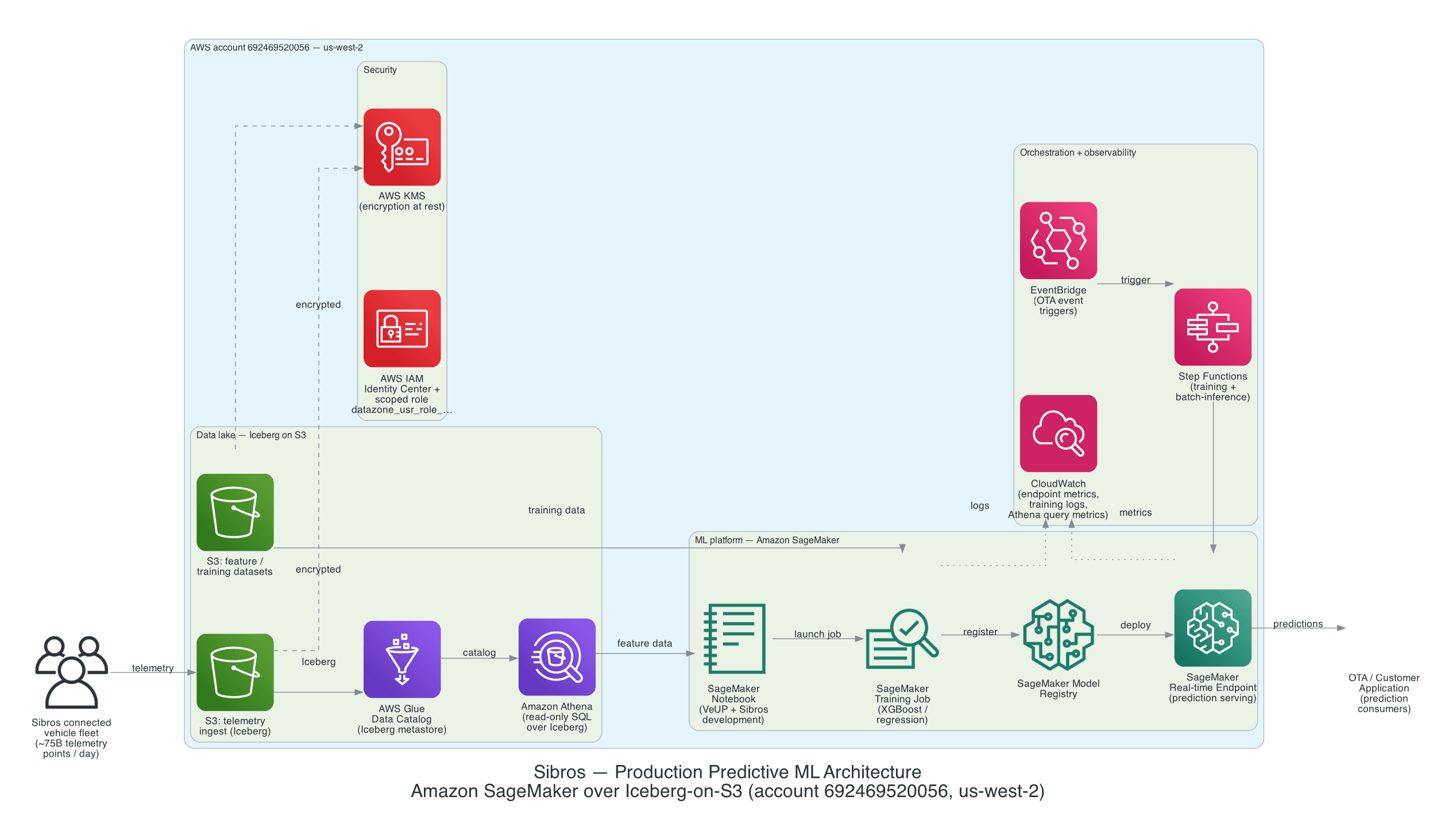
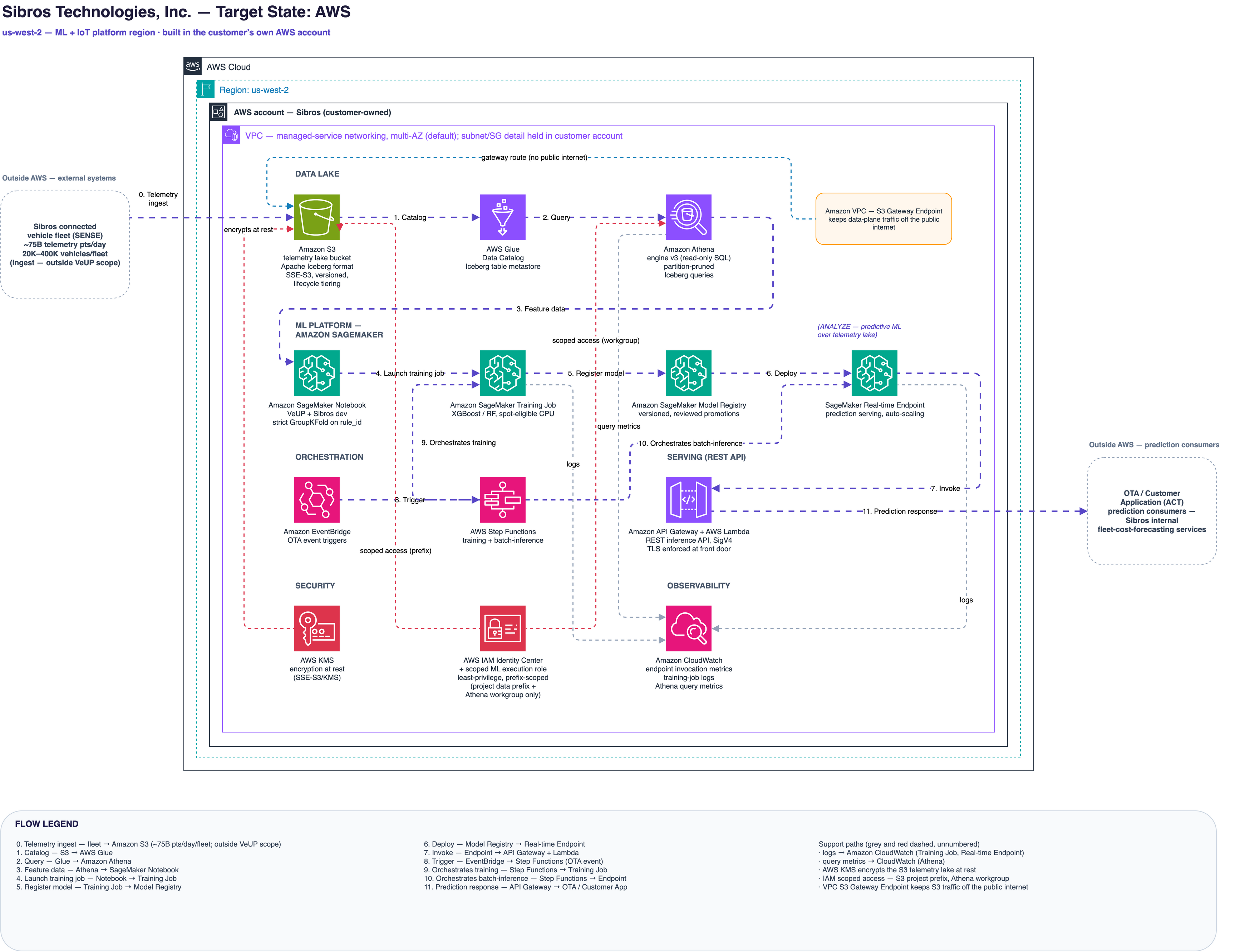
VeUP built the training and inference platform inside Sibros's own AWS account: Amazon SageMaker for managed training, the model registry, and real-time inference, sitting on an Apache Iceberg data lake in S3 with AWS Glue and Amazon Athena as the feature layer, orchestrated by Step Functions and EventBridge, secured with IAM Identity Center and KMS, watched by CloudWatch.
The decision that made the accuracy defensible: the validation cut was held out of training entirely, with multi-seed runs to bound seed variance, so the accepted figure reflects how the model performs on data it has never trained on.
The platform shipped at ~73% production accuracy (R² 0.73) on the 75-billion data-points-per-day workload, clearing the >70% contractual bar the engagement was written against. Sibros's engineers now run the pipeline themselves.
Architecture
The earlier attempts — local Python ML and GCP BigQuery ML — both capped below 70% accuracy at production scale, so VeUP built new on AWS: SageMaker training and real-time inference over the Iceberg-on-S3 data lake, with the Amazon Bedrock AgentCore OTA-decisioning pipeline calling the SageMaker endpoint as its prediction tool.
Where it started
Assessed baseline · new implementationConnected-vehicle telemetry — ~75B points/day · Fleets of 20K–400K vehiclesscikit-learn, XGBoost, and Random Forest models with ad hoc feature engineering on engineer laptops — not production capacity.
Regression models evaluated on GCP BigQuery ML as an alternative platform — also at non-production capacity.
Neither prior attempt could generalize to ~75B telemetry points/day of forecasting across 20K–400K-vehicle fleets.
A tight delivery clock and a frugality constraint — managed services only, no exotic infrastructure.
Forecast logged-data volume by vehicle type, logging config, and time window to price per-fleet OTA rollouts.
A new implementation on AWS — "a concept move," not a lift-and-shift; both prior systems were retired.
Production outcomes — customer-business KPIs
| KPI | Result |
|---|---|
| Production prediction accuracy on Amazon SageMaker | ~73% production accuracy (R² 0.73)on the 75B data-points/day workload, against a >70% contractual bar, measured on held-out validation excluded from training. |
| New AI/ML telemetry line of business | Production SageMaker platform enables Sibros to offer predictive AI/ML telemetry products to international automaker OEMs as a new line of business that did not exist before this engagement. |
| Customer-team independent operation | Sibros's engineering team runs the production Amazon SageMaker pipeline on its own — knowledge transfer was part of the delivery, not an afterthought. |
Where it went next
After accepting the first model in production at ~73% accuracy (R² 0.73), Sibros came back for more: a second engagement extended the platform in spring 2026.
 Amazon EventBridge
 AWS IAM Identity Center
 AWS KMS
 Amazon CloudWatch
 AWS Cost Explorer